

For hiring panels collecting scorecards in Slack & Teams
The debrief is Thursday. Two scorecards are missing.
Four interviewers, one candidate, one debrief on the calendar. By Wednesday night: Priya's scorecard is in, Lin's is in, Mike said he'd file his after standup, Tom hasn't answered. You're the one who has to walk into that room. If you just need the rubric, it's below — take it.
 Sarah · Monday 9:12am
Scorecards for Thursday's debrief please — all four by Wednesday EOD 🙏
Sarah · Monday 9:12am
Scorecards for Thursday's debrief please — all four by Wednesday EOD 🙏
 Mike · Wednesday
yep, right after standup
Mike · Wednesday
yep, right after standup
○ promised — not filed
thread staged with our recurring cast
01 · What Ayven does with the same panel
The set is collected before the room, not discovered in it.
Ayven asks each interviewer individually and tracks who has filed — a promise is not a scorecard, so "after standup" stays open until something lands. When a follow-up isn't working she changes strategy instead of repeating it, and a gap she can't close gets flagged to you the night before, with the decision spelled out.
02 · The register
The screening record moves on your say-so.
 Ayven APP · Thursday 8:40am
All four scorecards are in. The set reaches the debrief only when you accept — and an unattended ask expires instead of nagging.
Ayven APP · Thursday 8:40am
All four scorecards are in. The set reaches the debrief only when you accept — and an unattended ask expires instead of nagging.
Accept All approves future actions of the same type — decide once, not every time
03 · It's real
The product, not a promise.
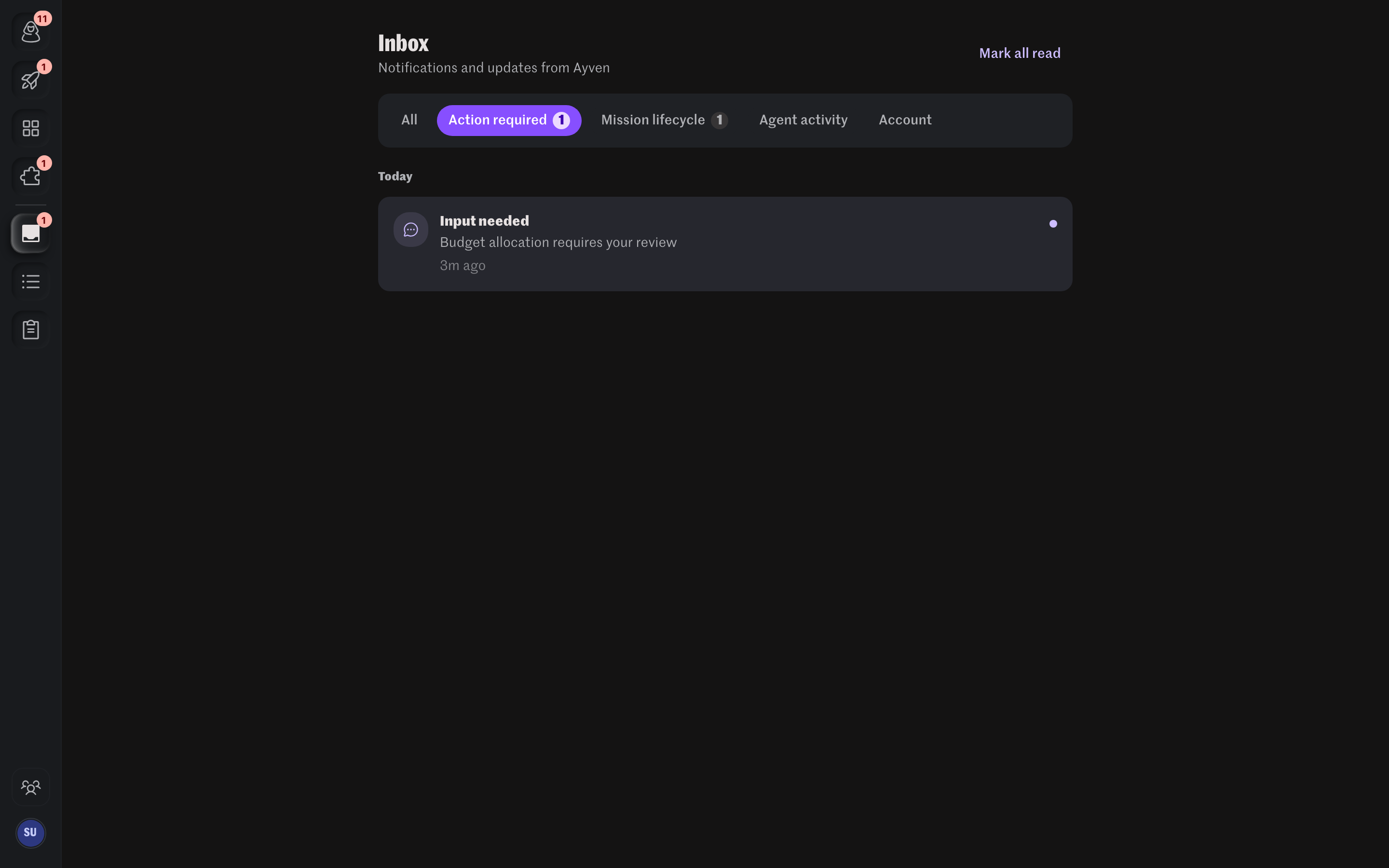
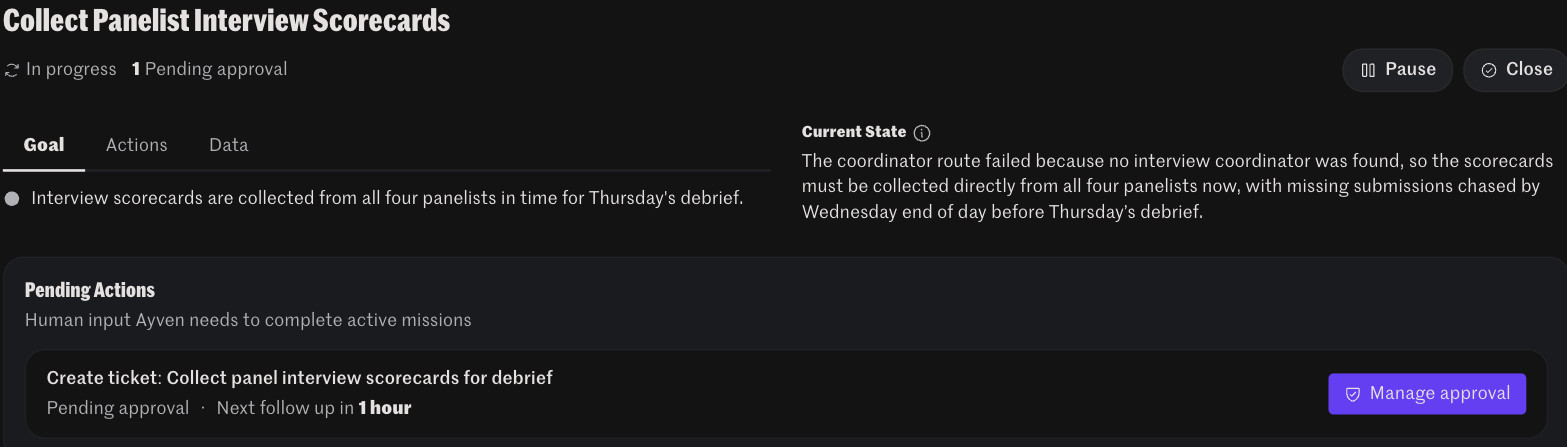
threads shown are staged with our recurring cast · screenshots are the live product
04 · The honest answer
Your ATS already sends reminder emails.
It does — to the same inbox where the last three died. Ayven asks each interviewer where they actually work — Slack or Teams — tracks who hasn't answered, follows up one at a time, and tells you the night before while there's still time to fix it. The reminder isn't the product; the collected set, in time, is.
05 · The scorecard template — take it
Four sections. Committed answers, not hedges.
Use it for the next loop, with or without Ayven.
1. Recommendation
Strong yes, yes, no, or strong no. Four options, no "leaning yes" — a scorecard that won't commit isn't a scorecard, it's a hedge with a candidate's name on it.
commit — no "leaning"2. Evidence per competency
Three or four competencies for the loop, each scored only on what you actually observed — with the question that probed it attached. "Seemed strong on system design" isn't evidence; "asked to design X, proposed Y, missed the failure case" is.
scored on what you saw3. Risks & unknowns
What your slot couldn't assess — a skill the questions didn't reach, a concern you can't confirm either way. Naming the gap is more useful to the debrief than a scorecard that pretends the interview covered everything.
what you couldn't see4. Would work with them again?
One line, yes or no. It cuts through a scorecard that reads well but doesn't actually answer the question the debrief is for.
the gut-check lineThe template is the easy part. Getting four of them filed by Wednesday night is the product.
Walk into Thursday with four of four.
Start freeshe asks each interviewer where they work · chases who hasn't filed · flags the gap the night before