

For the move captain
Forty tasks. Twelve days. One list-holder.
The full checklist is below — phase by phase, free to copy, no email gate. And the honest part: the checklist isn't what makes moves hard. Getting a dozen internal owners to actually do their items by their T-minus dates is. Every item on the list is someone's second priority — except yours.
 Sarah · T-4 weeks
badge access list is due Friday — owners, can you each confirm your items? 🙏
Sarah · T-4 weeks
badge access list is due Friday — owners, can you each confirm your items? 🙏
○ 9 of 14 confirmed
 Mike · Thursday
the internet install… I thought facilities had that one?
Mike · Thursday
the internet install… I thought facilities had that one?
thread staged with our recurring cast
01 · Ayven runs the internal chase
Hand her the checklist. Keep the date.
Each item becomes a held loop in Slack or Teams with a named owner and a T-minus date — who owes what, by when — chased person-by-person with urgency that tightens as the immovable date approaches. She remembers what she already tried, so quiet gets a different move, not the same nudge again.
02 · The register
"Sorted" isn't an answer she records.
 Ayven APP · T-2 weeks, 9:15am
The cutover items were tracked as tickets, so I checked Jira instead of taking "sorted" for an answer — the state actually changed there. The risk column reflects the work, not the replies.
Done — Jira · 09:15
Ayven APP · T-2 weeks, 9:15am
The cutover items were tracked as tickets, so I checked Jira instead of taking "sorted" for an answer — the state actually changed there. The risk column reflects the work, not the replies.
Done — Jira · 09:15
items outside a tracker — badges, packing, sign-offs — are held as loops on people's answers
03 · It's real
The product, not a promise.
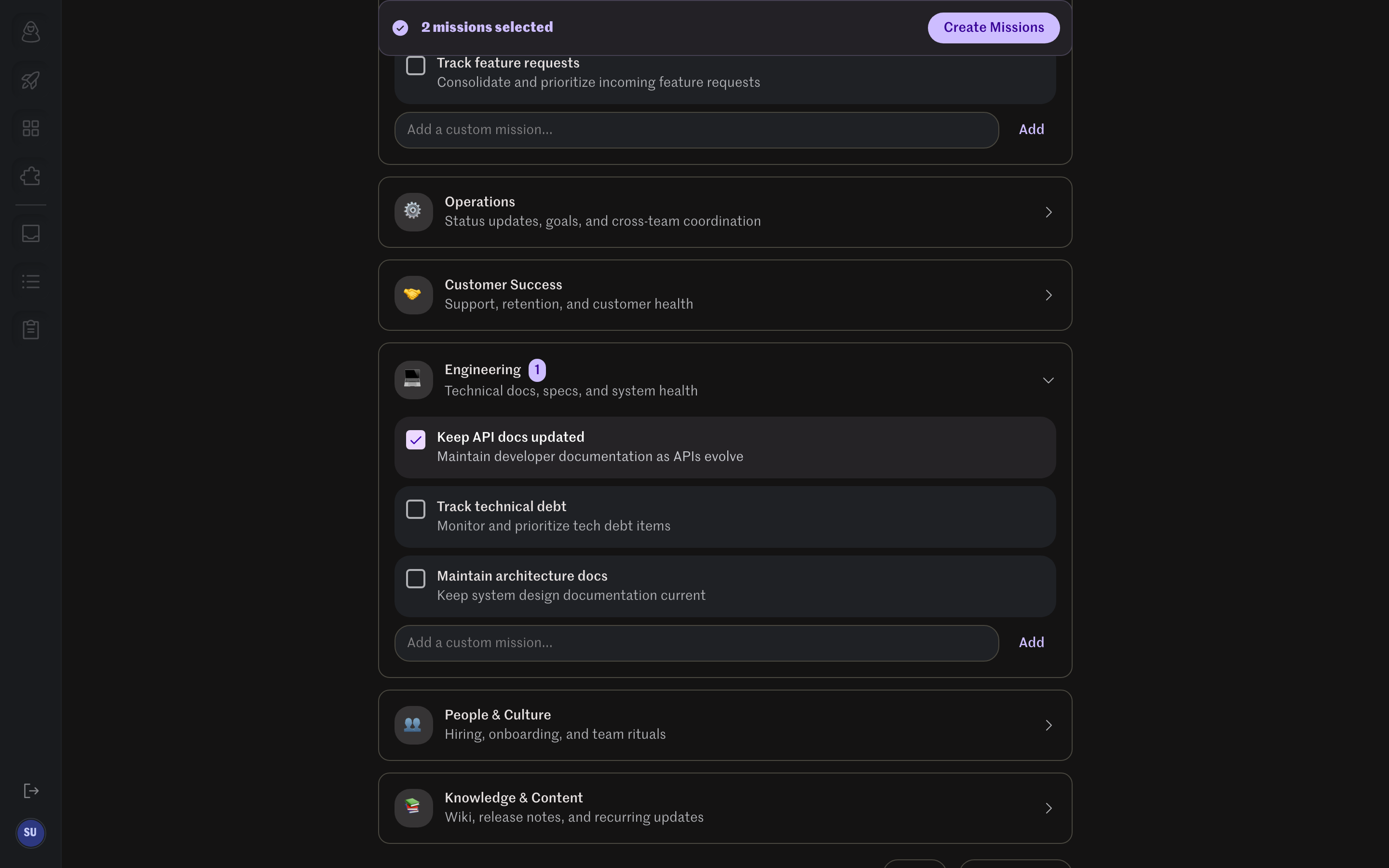
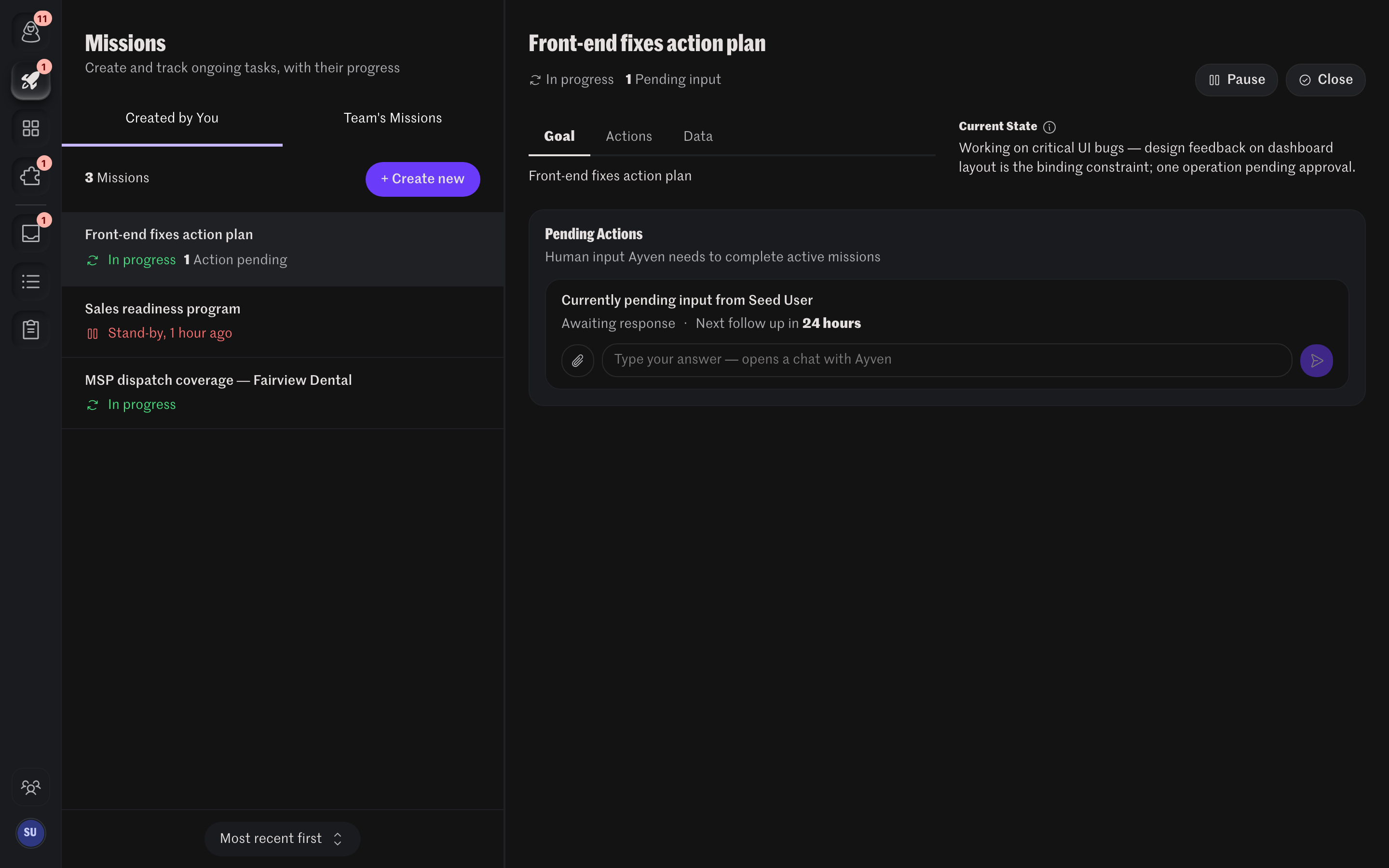
threads shown are staged with our recurring cast · screenshots are the live product
04 · The checklist, if that's all you need
T-minus by T-minus, worked back from move day.
Every item needs a named internal owner and a date — "the office" owns nothing.
T-12 weeks — Scope & headcount
Confirm headcount moving plus 12-month growth allowance · name the move captain and one owner per workstream · set the immovable move date and work every deadline back from it · confirm lease dates on both offices with whoever manages them internally.
T-10 weeks — Seating & floor plan
Draft the floor plan: team zones, meeting rooms, quiet rooms, storage · map desk assignments — every person, every desk · circulate to team leads for sign-off with a reply-by date · lock the plan; late changes go through the move captain only.
T-8 weeks — IT & network cutover
Internet install date confirmed by your IT owner — the longest lead time on the list · plan switches, Wi-Fi survey, access points, comms room · decide what's cloud, what physically moves, what gets retired · book the cutover window and the person running it.
T-6 weeks — Desks & equipment audit
Audit monitors, docks, chairs, whiteboards — moves, replaced, or disposed · order anything new to arrive at the new office · tag equipment to desk assignments · plan disposal or donation for what stays behind.
T-4 weeks — Access, badges & safety
Badge or access system set up; full staff access list submitted · keys, alarm codes, and out-of-hours access assigned · parking and bike storage allocated · fire wardens and first aiders named for the new floor.
T-4 weeks — Address updates
Company registrations, bank, insurance — one internal owner per record · website, invoices, email footers, contract templates · mail redirect ordered from the old address · every supplier relationship updated by its internal owner.
T-2 weeks — Packing owners
One packing owner per team; crates and labels distributed · labelling scheme agreed: team, desk number, contents · personal-desk rule announced — each person packs their own by a set date · shared areas each get a named owner.
T-1 week — Comms & move-week plan
All-hands note: dates, who works where, first-day instructions · move-day schedule: what moves when, who's on site at each end · remote-work plan for anyone displaced during the cutover · final walkthrough against the floor plan.
Move weekend — Execution
IT teardown at the old office; re-rack and test at the new one · floor marshals at both ends checking crates against the plan · network, Wi-Fi, printers, and meeting rooms tested before Monday · snag list started — everything imperfect written down, not fixed ad hoc.
Day one & week one — Support and close-out
Help rota staffed for the first morning: IT, facilities, one floor guide · Wi-Fi, printer, and room-booking info posted at every zone · snag triage in one channel with one owner, worked to zero · old office cleared and handback prepared · access list reviewed · retro: what slipped, what to write down for next time.
"What about the movers and the landlord?"
Straight answer: they're yours. Ayven chases your internal team only — she doesn't contact movers, landlords, or vendors. "Confirm the movers are booked" is still a loop she holds — assigned to your office manager, chased until it's done. The vendor call is theirs; making sure it happens on time stops being yours. And your fourteen owners don't install anything or learn a tool — they answer a check-in in Slack or Teams, where they already are.
You have the checklist. Ayven runs the chase.
Start freeevery item an owned loop, chased toward the date that doesn't move · one digest a day of what's truly at risk