

For the launch owner
Two weeks to launch. 'Should be fine' isn't a status.
The full checklist is below — every phase, an owner per item, free to copy, no email gate. And the honest part: the list isn't what sinks launches. The items are owned by people on three different teams, launch day doesn't move, and someone has to keep every loop closed.
 Sarah · two weeks out
launch is the 14th — are the tracking events verified? is the support macro written? did legal sign off?
Sarah · two weeks out
launch is the 14th — are the tracking events verified? is the support macro written? did legal sign off?
○ asked in 3 channels — 1 answer
 Mike · 5:41pm
events fire in staging, prod should be fine 🤞
Mike · 5:41pm
events fire in staging, prod should be fine 🤞
thread staged with our recurring cast
01 · Ayven holds the launch together
Every item an owned loop, chased across three teams.
Hand Ayven the checklist and each item gets a named owner and a date worked back from launch — held open in Slack or Teams until it's confirmed closed. She follows up with each owner individually — the eng lead about the build, the support lead about macros, the marketer about the announcement — with urgency that tightens as launch day approaches.
02 · The register
"Done in conversation but not in reality" gets caught early.
 Ayven APP · T-7 days, 10:20am
Two eng items said "done" and pointed at tickets, so I checked the tracker instead of the thread. One really was done. The other went back on the risk list — at T-7, not on launch day.
Ayven APP · T-7 days, 10:20am
Two eng items said "done" and pointed at tickets, so I checked the tracker instead of the thread. One really was done. The other went back on the risk list — at T-7, not on launch day.
sign-offs, macros, drafts — items outside the tracker are held as loops too
03 · It's real
The product, not a promise.
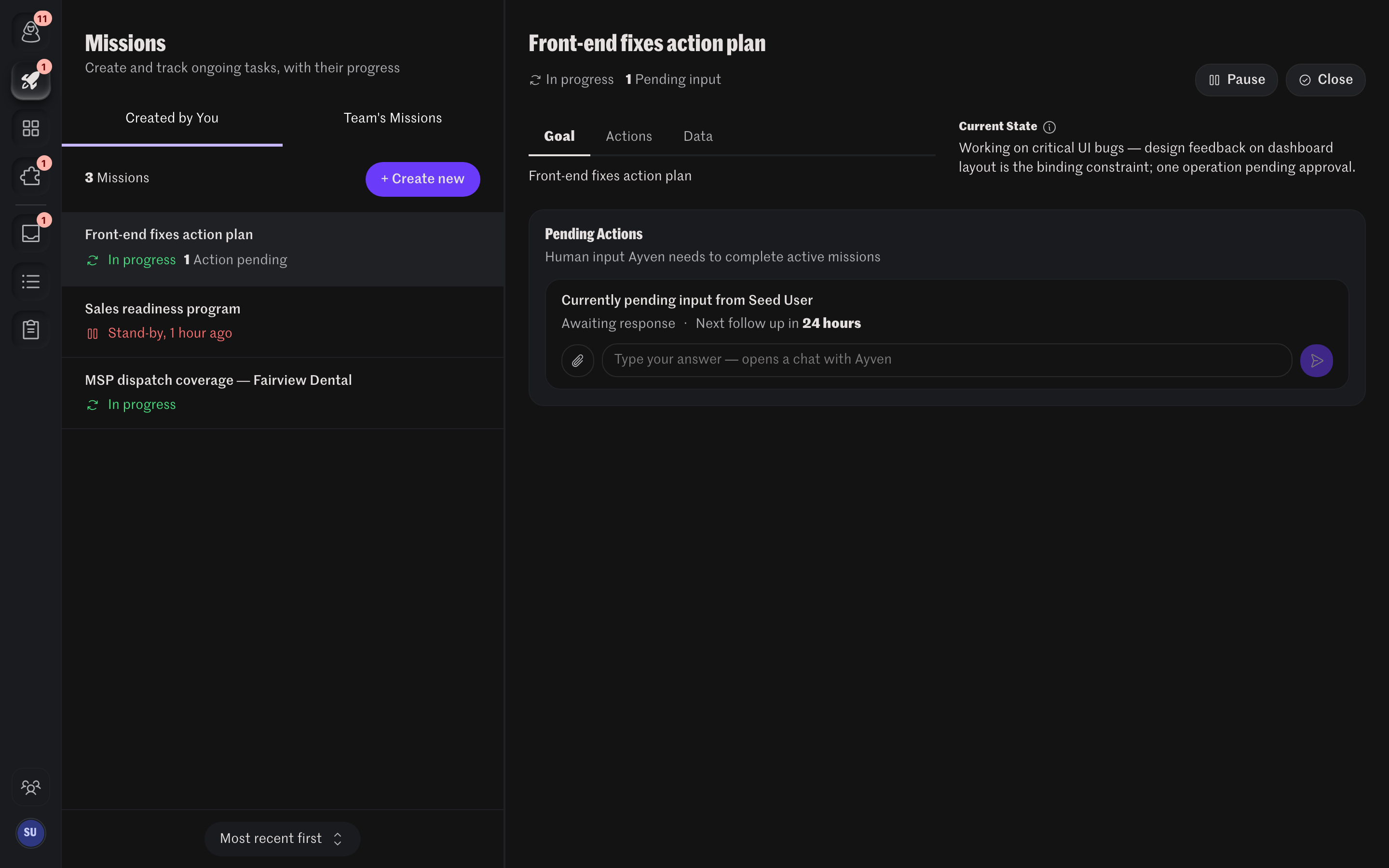
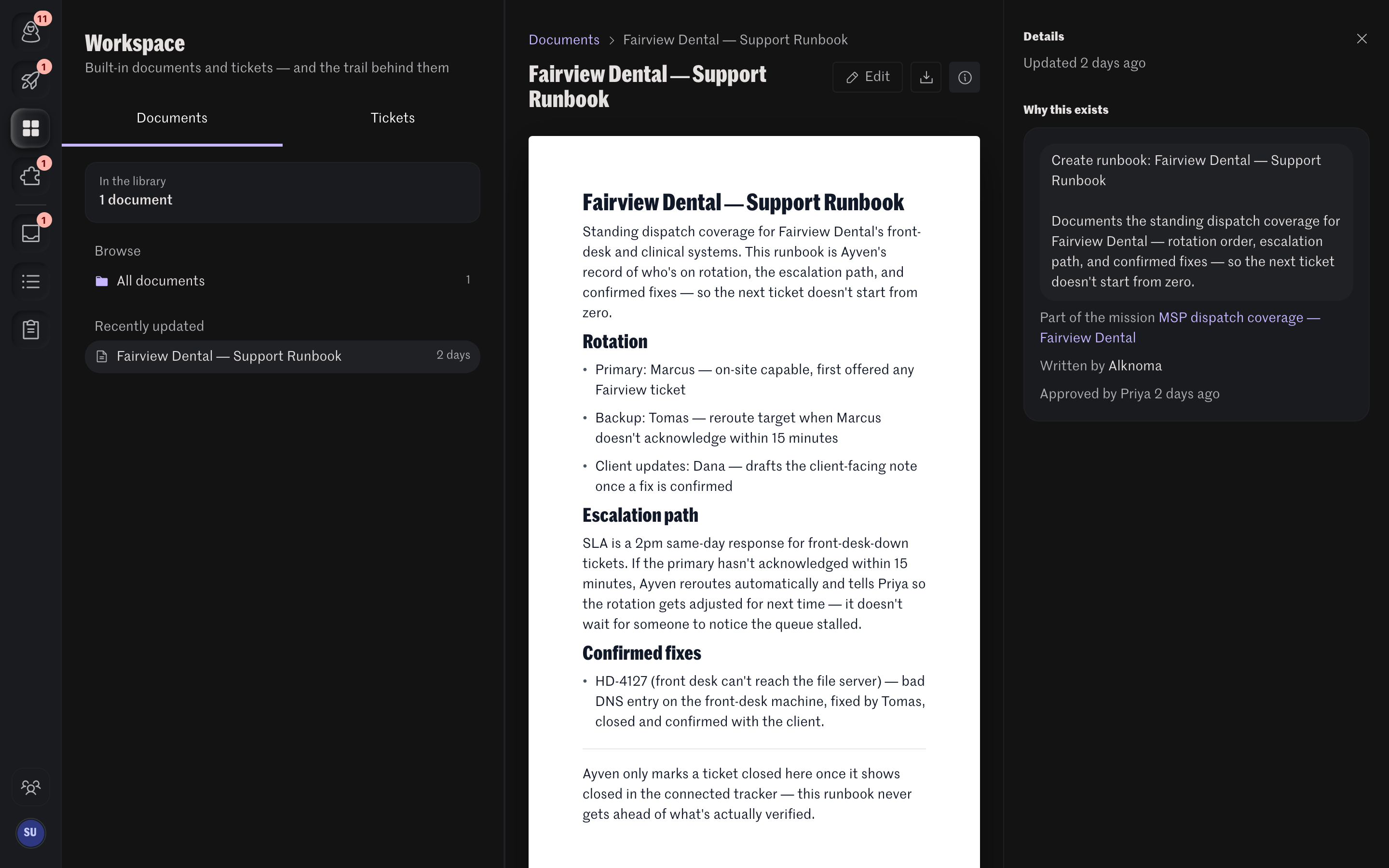
threads shown are staged with our recurring cast · screenshots are the live product
04 · The checklist, if that's all you need
Phase by phase, an owner per item.
Every item gets one named owner and a date worked back from launch. "Marketing" owns nothing; a person does.
1. Positioning & pricing sign-off
One-sentence positioning agreed and written down · pricing and packaging signed off by whoever can actually say yes · naming final across product, docs, and announcement · sign-off recorded with a name and a date, not a meeting memory.
2. Scope freeze & release build
Launch scope frozen — a cut list exists and everyone has seen it · release build tagged; ship-blocking bugs triaged to zero or waived by name · feature flags and rollout plan written down · QA pass on the exact build that ships.
3. Docs & changelog
User docs drafted, reviewed by someone who didn't build the feature · changelog entry in the product's voice · screenshots match the shipping UI · docs publish scheduled to go live with the release, not after it.
4. Support readiness
Support macros and FAQ written for the questions you know are coming · support team walked through the feature before customers see it · escalation path named · known limitations documented internally so answers are consistent.
5. Tracking & analytics events
Success metrics agreed before launch day · tracking events specced, implemented, and verified firing in staging · dashboards ready so day-one numbers are readable · attribution checked end-to-end on the signup or upgrade path.
6. Announcement & assets
Announcement post drafted, reviewed, and scheduled · email, social, and in-app messages written and queued · landing page updated and staged behind the release · embargoes and publish times agreed across every channel owner.
7. Internal enablement
Sales and customer-facing teams briefed: what it is, who it's for, what it costs · demo script or sandbox account ready · internal announcement drafted so the company hears before customers ask · objection answers shared where the team will find them.
8. Legal & compliance
Terms, privacy, or DPA changes reviewed if the feature touches data · claims in the announcement checked against what the product actually does · third-party licenses cleared · sign-off recorded with a name and a date.
9. Rollback & incident plan
Rollback steps written and tested — flags off, revert path, data implications · go/no-go criteria agreed before the day, not during it · on-call owner named for launch day and the day after · status-page templates drafted for the bad timeline.
10. Launch day & the week after
Hour-by-hour run sheet: release, docs, announcement, email, social · one channel where each step is reported done · owner watching errors and support volume from the first hour · daily metrics read against success criteria · support themes routed to the product owner · fast-follow fixes owned and dated · retro.
"We already track this in Jira."
Good — keep it there. The tracker is where eng work belongs. But half this checklist can't live in a sprint board: pricing sign-off, support macros, the announcement, legal review. Those live in conversation — and Ayven holds them as loops there, with the same owners and dates as everything else. And a ticket sitting in "In progress" doesn't follow up with its assignee; Ayven does — checking the tracker before nudging, so the chase reflects the real state of the work. Rerouting, escalation, and anything drafted on your behalf are approval-gated: she proposes, the launch owner signs off.
Launch day doesn't move. Every loop should be held.
Start freeowners chased across eng, marketing, and support · ticket-linked items verified in the tracker · one daily digest of what's truly at risk