

For teams collecting answers in Slack
Nine of fifteen voted. The answers that matter are missing.
The poll went out Tuesday. By the afternoon nine of fifteen had voted — and two of the silent six are the people whose answer you actually need. So the chase starts by hand: scroll the reactions, work out who's missing, DM them one at a time, keep the running tally in your head. If a plain vote count is all you need, Slack already does that — three ways, below.
 Sarah · Tuesday 9:04am
📊 Who's on-call over the break? ✅ or ❌ by Thursday please!
Sarah · Tuesday 9:04am
📊 Who's on-call over the break? ✅ or ❌ by Thursday please!
○ 9 of 15 voted
Sarah · Thursday
Tom, Lin — did you see the poll? Also counting Priya's thread reply as a yes… I think.
thread staged with our recurring cast
01 · What Ayven does with the same question
Collect-and-chase, not count-and-hope.
Ayven asks each person in Slack or Teams and tracks who has answered — per person, not a vote count. When a reminder isn't working she changes strategy instead of sending the same one again, routes around absence, and posts one composed result: who's in, who's out, what's still open.
02 · The register
Answers about tracked work get checked.
 Ayven APP · Friday 2:32pm
Lin's answer pointed at tracked work, so I checked GitHub instead of taking the reply's word for it. One composed result went to the channel — who's in, who's out, what's still open. No tally to stitch together.
Ayven APP · Friday 2:32pm
Lin's answer pointed at tracked work, so I checked GitHub instead of taking the reply's word for it. One composed result went to the channel — who's in, who's out, what's still open. No tally to stitch together.
the result is composed from what's verified, not from memory
03 · It's real
The product, not a promise.
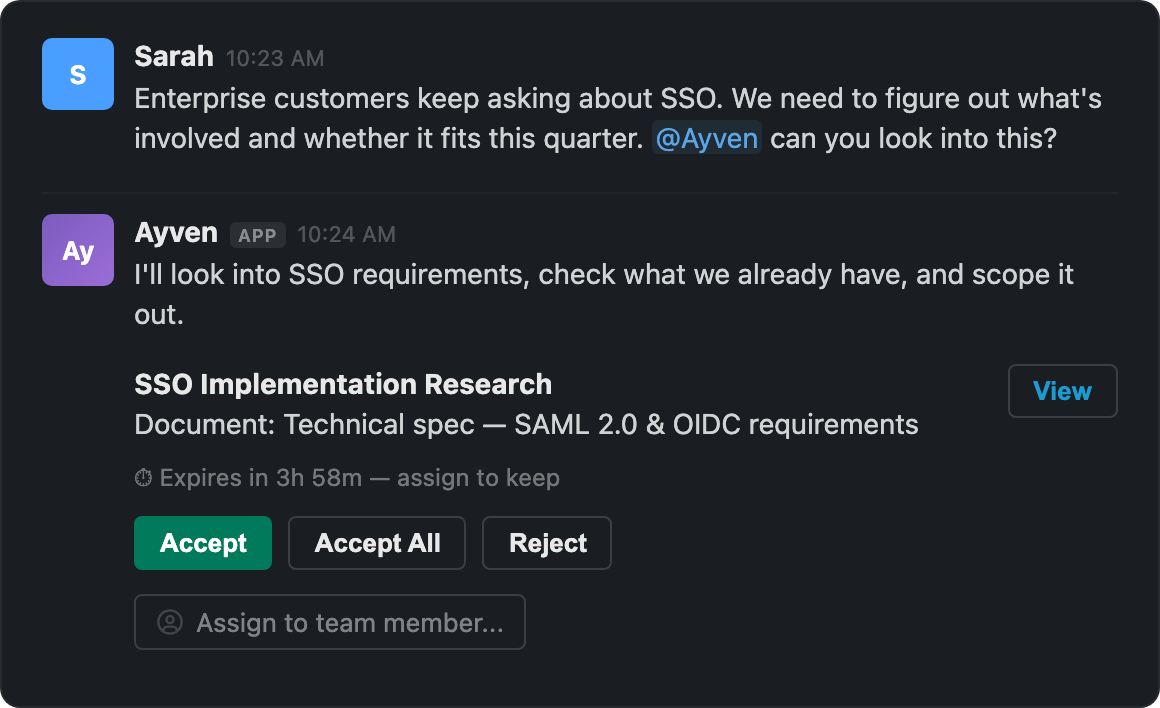
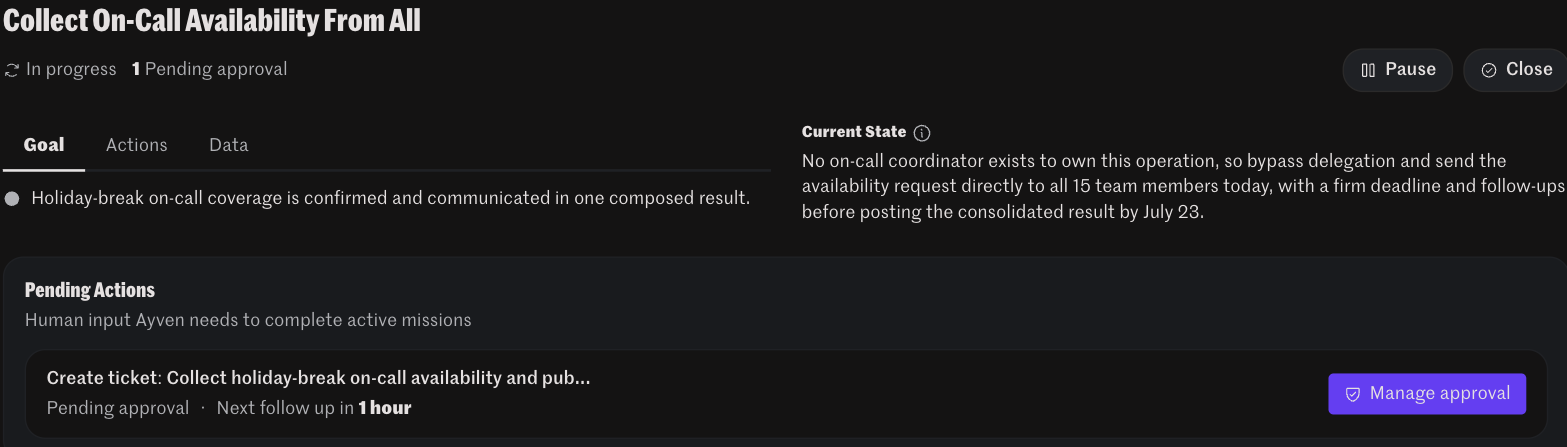
threads shown are staged with our recurring cast · screenshots are the live product
04 · The honest answer
Slack does polls fine. This is a different job.
Honest answer first: Slack does polls fine — three ways, one with no app at all — and if a vote count settles your question, any of them does it in minutes. Ayven is not a poll widget. A poll and a headcount look alike, but they're different jobs.
A poll counts votes
A poll collects votes from whoever happens to see it, and the majority wins. For lunch spots and meeting slots that's exactly right — Slack's own methods settle it in minutes, and Ayven has nothing to add.
majority questions — use a pollA headcount needs everyone
Who's on-call over the break, who's confirmed for the offsite, who has reviewed the doc — those aren't majority questions. The job is collect-and-chase: ask each person, track who hasn't answered, follow up with them, compose one result. A poll does the first step and stops.
every-person questions — collect-and-chaseSilence changes the strategy
When someone doesn't answer, the next move is not the same reminder, louder. Ayven moves to a direct message, tries whoever's covering when someone is away, and tells you when the next follow-up lands — repeat nudges to the same person are spaced at least a day apart, and every chase has a point where it stops and reports back instead.
strategy changes · pinging stopsThe result is composed
Instead of a reaction tally plus a thread plus your memory, Ayven posts one answer: who said what, who's confirmed, what's still open and why. And when an answer is about tracked work, she checks the connected tracker — Jira, YouTrack, or Asana — rather than taking the reply's word for it.
checked in the tracker where linkedRun today's poll in Slack. Hand Ayven the headcount.
Start freegive her the question and the list · she asks, tracks, chases, and posts one composed result