

For whoever assembles the weekly roll-up
Five asked. Two answered. One answered a different question.
There was a format last week too. What was missing was everyone's piece of it, on time. Each workstream gets pinged for their piece; some answer, some answer late, some answer a different question — and the re-asking starts an hour before the update is due. If you just need a format, the one below is clean — take it.
 Sarah · Friday 9:12am
weekly roll-up goes to leadership at 4. can each workstream send me their piece by 2? 🙏
Sarah · Friday 9:12am
weekly roll-up goes to leadership at 4. can each workstream send me their piece by 2? 🙏
○ 3 of 5 answered
 Mike · 2:47pm
wait — did you mean this week or the whole sprint?
Mike · 2:47pm
wait — did you mean this week or the whole sprint?
thread staged with our recurring cast
01 · What Ayven does with the same roll-up
Collect-and-compose is Ayven's literal loop.
The thing you do by hand every week is the thing Ayven runs as a routine in Slack and Teams. She asks each person for their piece individually, async — and tracks who still owes what by when, so gaps surface before the deadline. Everything collected lands as one composed update to the channel, in one voice — not a wall of raw replies.
02 · The register
Reported vs. verified.
 Ayven APP · Friday 3:12pm
One piece said "shipped" and pointed at a ticket, so I checked the tracker instead of pasting the reply. The update reflects the state of the work, not just the state of the replies.
Ayven APP · Friday 3:12pm
One piece said "shipped" and pointed at a ticket, so I checked the tracker instead of pasting the reply. The update reflects the state of the work, not just the state of the replies.
no tracker linked? the loop runs on answers alone
03 · It's real
The product, not a promise.
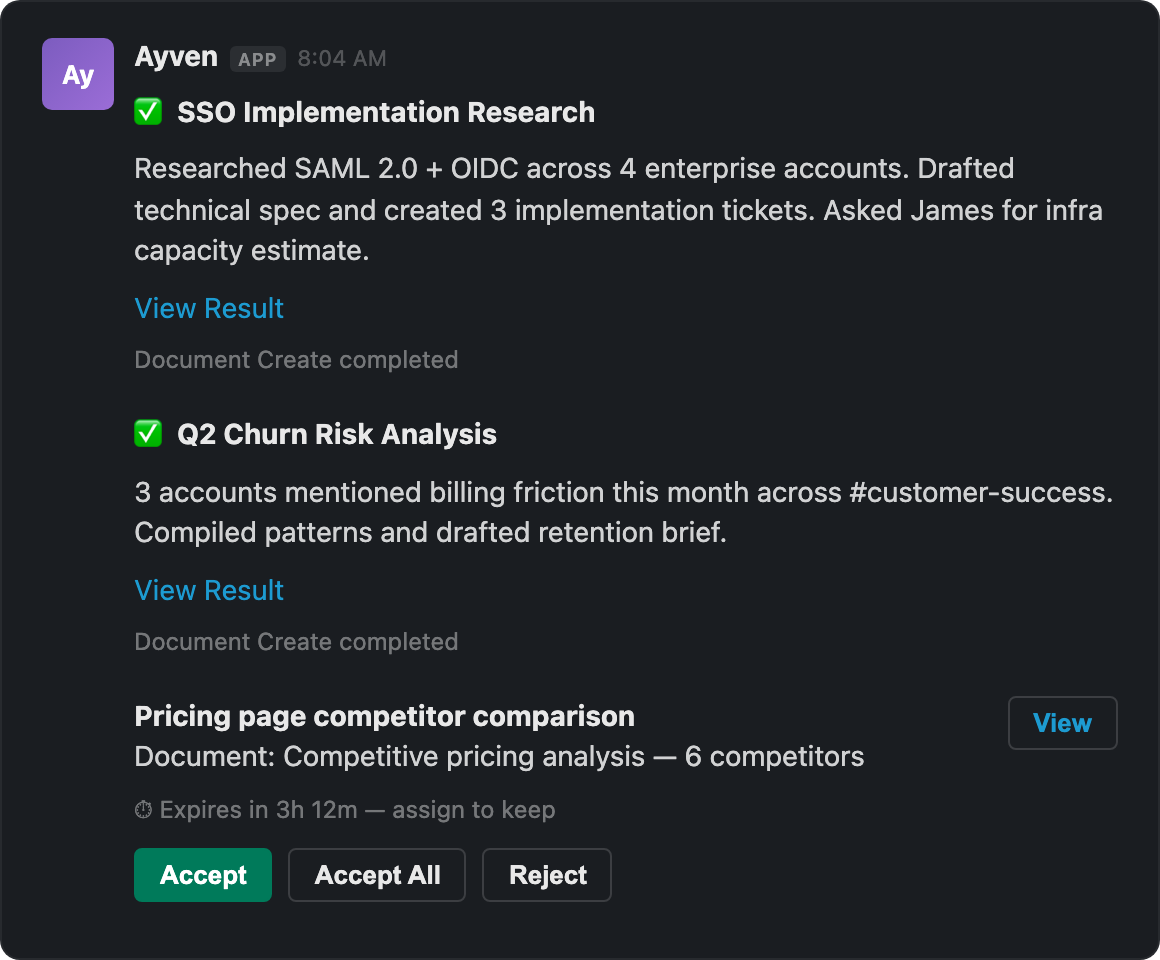
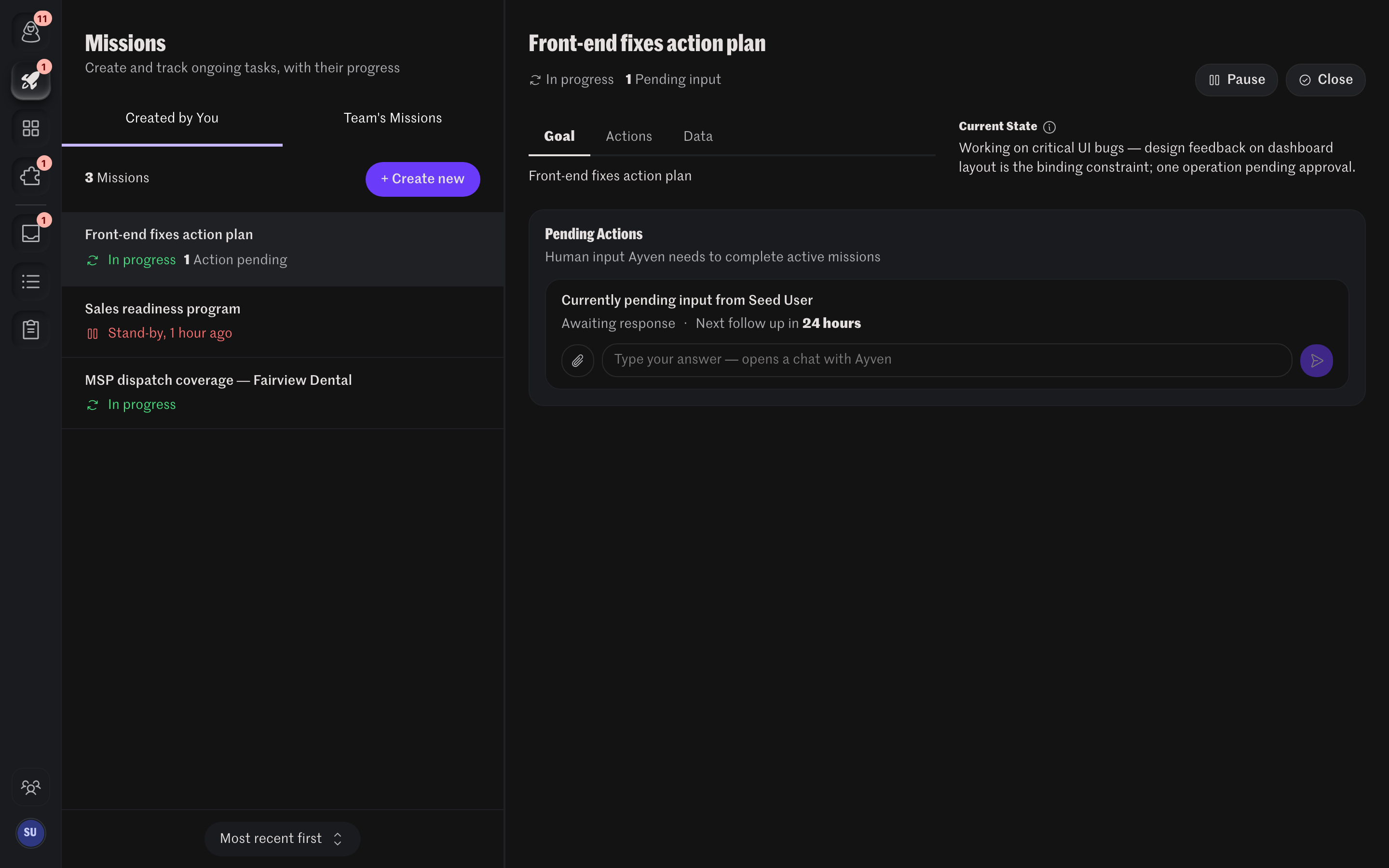
threads shown are staged with our recurring cast · screenshots are the live product
04 · The format, if that's all you need
One line of headline, three short sections.
If it doesn't fit on one screen, it won't get read.
Headline
One sentence: on track, at risk, or off track — and the single biggest reason why. The reader who stops here should still leave informed.
the only part some readers seeWhat moved
Concrete progress since the last update, per workstream. Outcomes, not activity — "shipped X" and "decided Y," not "continued working on."
outcomes, not activityWhat's blocked
Each blocker with who or what it's waiting on, and the ask that would unblock it. A blocker without an ask is just a complaint.
every blocker carries an askWhat's next
What will be true by the next update, with an owner per item. This is the line you'll grade next week's "what moved" against.
owner per item"Isn't this just a standup bot?"
A standup bot broadcasts a prompt and pastes whatever comes back — the hard part of your week is everything that doesn't come back. When someone goes quiet, Ayven doesn't just repeat the prompt: she checks the linked tracker where there is one, reroutes around an absence, or escalates with context — and she remembers what she already tried. Where work is linked to Jira, YouTrack, or Asana, ticket-linked work counts as done only when the ticket shows the change. And the channel gets one readable update in the format above, not a stack of raw responses. That assembly was your job; now it's Ayven's.
Keep the format. Stop being the collector.
Start freeshe asks each person, chases who hasn't answered, and posts one composed update to the channel · every week, without you assembling it